The Stain on the Rug
The agency called it a placement. Elena Vega called it rent.
She had been on the Marchetti list for eleven months, taking whatever came up — a week in Darien, four days covering a christening in New Canaan — and on the third Tuesday of October a dispatcher named Angie called at six in the morning and said a house in Greenwich had lost a girl overnight and needed someone by eight.
Elena did not ask whose house it was.
In her experience the answer was always a surname she had never heard, and the surname never came out to meet her anyway.
She took the 6:41 train with her uniform folded in a tote bag and one thing in the pocket of her apron, the way she had carried it since she was five years old.
It was a photograph.
It was four inches by three, printed on paper that had gone soft as cloth at the corners, and it showed a dark-haired young woman standing on a wide stone step with a baby on her hip.
Behind them was a house — pale, enormous, a black front door with a brass knocker shaped like a ring.
Elena had studied that house since she was a child in a room with seven other beds, the way other children studied maps of countries they meant to visit.
She knew the woman was her mother.
She did not know anything else, and by twenty-four she had mostly stopped expecting to.
---
The house in Greenwich had a gravel turnaround and a black front door.
Elena noticed the door.
She noticed it the way you notice a word in a language you used to speak — and then she did what she had trained herself to do at nineteen, after the fourth time, and made herself stop.
Every third house between here and Rye had a stone step and a black door and a brass knocker.
She had walked up to six of them in eleven months and stood there with her heart going and been wrong six times, and the sixth time she had cried in a downstairs bathroom in Darien for twenty minutes over a doorknob.
So she went around to the service entrance, the way you are supposed to, and a woman in a housekeeper's cardigan let her in and started talking about the schedule, and the moment passed the way such moments do.
By four in the afternoon she had done two bathrooms and the back stairs, and Mrs. Bellweather came in from the club.
Elena had not met her yet.
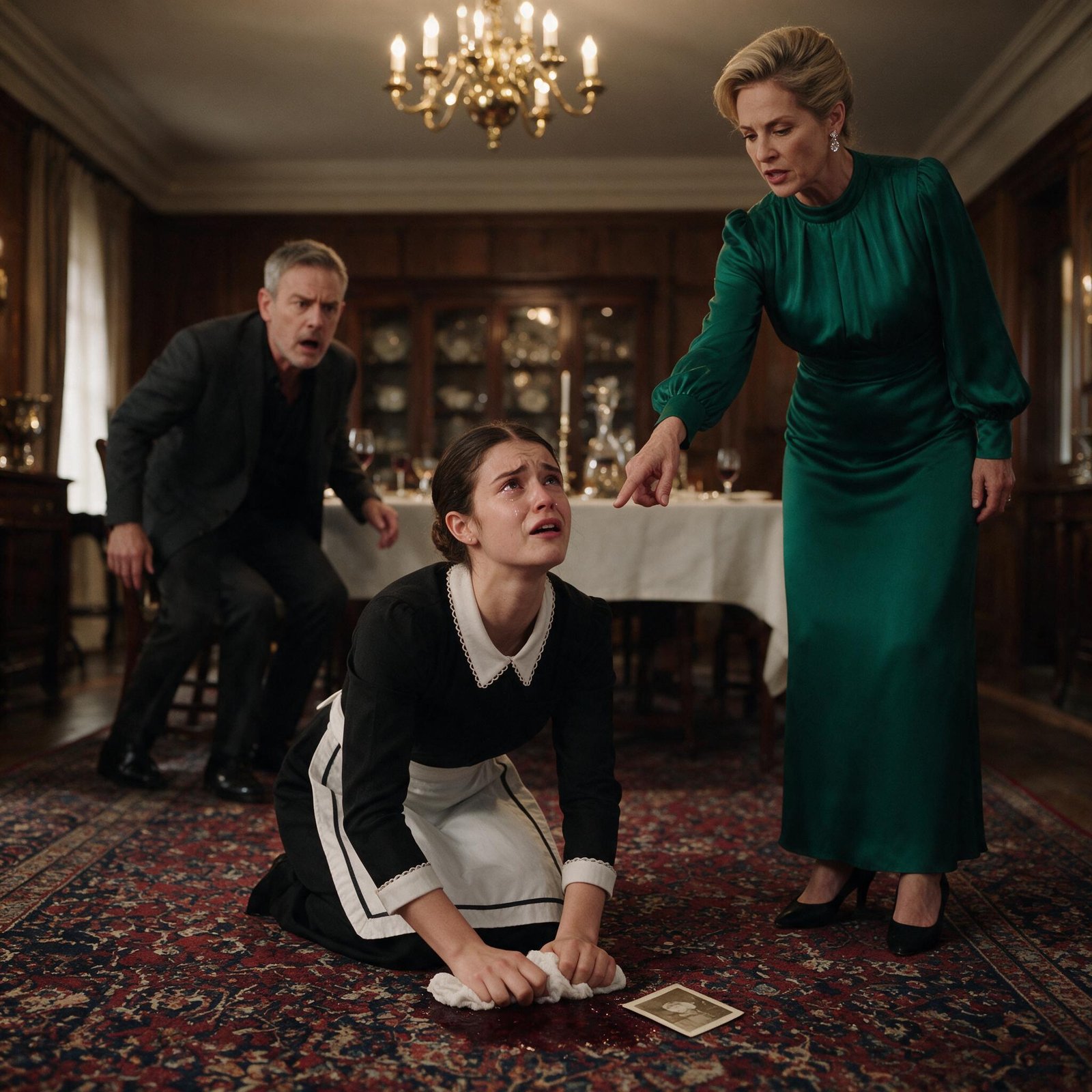
She was a tall blonde woman in an emerald silk dress with her hair up, and she moved through the dining room the way weather moves through a valley, and she stopped at the head of the table and set her glass down too close to the edge.
Whether she knocked it deliberately, Elena would never be sure.
The glass went over. The wine went across the rug in a dark tongue, into the red, into the pattern, and the whole room smelled instantly of it.
"Oh," Mrs. Bellweather said, without any particular feeling.
Elena was already moving for the cloth.
She went down on both knees on the rug and started to work at the edge of the stain, and above her the silk dress did not move away.
"Kneel," Mrs. Bellweather said. "And don't get up till it shines."
Elena said nothing.
She had been spoken to like that before, in other houses, by other women, and she had learned that the answer was to make yourself small and let the sentence go over you.
She leaned forward onto her elbow to reach the deep part of the stain.
She did not feel the photograph slide out of her apron pocket.
---
She heard the footsteps first.
A man came in through the far doorway, still in his coat, keys in his hand, the particular tiredness of a man who has been talking to lawyers all day.
He stopped.
He was not looking at his wife, and he was not looking at the woman on the floor.
He was looking at something small and pale lying face-up on the dark red rug about a yard from Elena's knee.
He crossed the room without saying anything.
He crouched, and he picked it up, and Elena finally looked up and saw what was in his hand and felt her stomach drop out of her body.
"Where did you get this?" he said.
His voice was not angry. That was the strange part. It came out thin, like a man asking about a symptom.
"It was my mother's," Elena said. "They told me she died in a fire."
She was crying before she finished the sentence and she hated that, and she stayed on her knees because nobody had told her she could get up.
"Ross." Mrs. Bellweather had not moved. Her chin had come down half an inch and her voice had gone flat and quick. "She's the help."
He did not seem to hear her.
He was holding the photograph in both hands now, up near his face, and his thumb was moving over it, and Elena watched a fifty-five-year-old man's mouth start to come apart.
He looked at the woman on the stone step.
Then he looked at the black front door behind her, which was nine feet from where he was standing, on the other side of the wall.
Then he looked down at Elena.
"You have her eyes," he said.
And then he turned on his wife so fast that the housekeeper in the hall dropped a stack of napkins, and he screamed at her with the photograph shaking in his fist.
"You told me the baby died!"